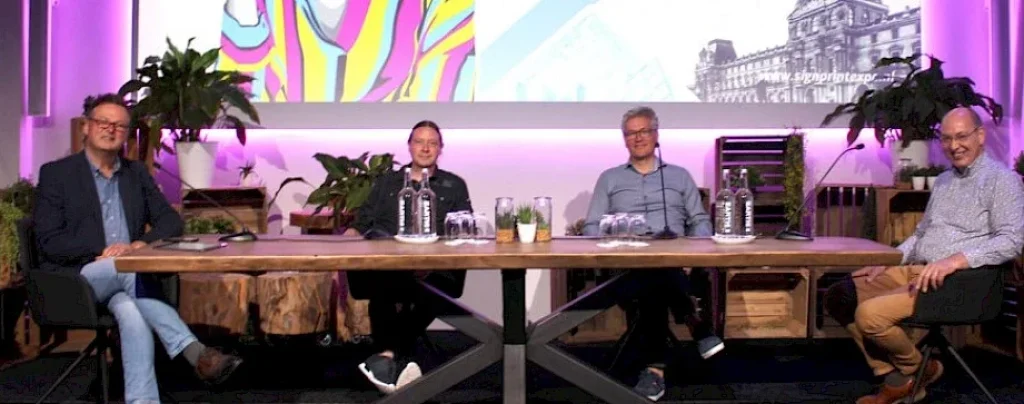
Germen Kroon was a guest at the Sign & Print Expo webinar organised by Easyfairs, about automation and inkjet in the graphic industry.
A small group of graphic professionals visibly enjoyed the physical mini-event at the Evenementenhal Gorinchem. Online, more than 100 interested viewers watched this gathering of specialists via a live webinar about automation and inkjet in the graphic industry. In the brand-new studio on the first floor, Peter Luit presented the webinar in three blocks.
Accelerated automation processes
Software developers Germen Kroon (GrafiStore), Theo van den Broek (ISI) and Ramon van Wingerden (Prindustry) formed the panel with knowledge of automation in the graphic industry — Germen and Theo mainly from the workflow side, Ramon from e-commerce. Peter's first burning question: "Is there a lasting impact of automation to be seen?" All three could confirm this from their own field.
Germen: "We see more and more graphic companies wanting to automate their processes. Many people have started working from home, so processes have to connect even more efficiently."
Ramon: "We notice that many of our graphic customers want to automate more — these are the larger brand owners. We then work together with the graphic entrepreneur on a dedicated online ordering system for such a brand owner. Graphic entrepreneurs are strong in print production, but for the IT question they go to a software partner."
Theo: "Automation also happens because no new people are hired for roles that can be automated. Online, you see that sales no longer come only from the traditional graphic corner; the packaging industry too increasingly offers standard packaging online."
IT is a profession of its own
For many companies, automating processes is too complex to develop themselves. "At the same time, a good IT specialist costs something, and graphic companies are not the most attractive places for them to work", says Germen. "Graphic companies therefore mainly choose external software partners, who have to know the entire graphic process from A to Z in order to automate it. As a software developer you must be able to translate this process correctly in technical terms and then train the staff on it."
Theo continues: "You also have to be a business advisor. Every graphic company asks itself what the future looks like. When you sit at the table with customers, you talk about the whole ecosystem. Are you still able to produce efficiently? What can you do to reinvent yourself as a smaller graphic company, as an intermediary? These are questions related to automation."
Ramon, finally: "Far-reaching automation actually offers opportunities too. Designing business cards is very old, but in the past year I see big leaps here. CHILI publish, for example, develops smart templates: a single house-style template can dynamically generate multiple formats for print and web."
The rise of inkjet
That inkjet has taken off enormously is no secret. Although the technology has been around for a while, trade media worldwide have pounced on it in recent years. Developments are going considerably faster than in offset and toner. Frank Huigen (Canon), Marcel Martens (HP) and Ewout Maartense (Landa) shed light on this in the second block.
Ewout: "There are two important developments driving the growth of inkjet. You see volume falling for offset presses and there is clear growth in packaging. That plays into digital's hands."
Marcel: "Offset will continue to exist alongside digital, but the market wants ever faster and more efficient production — and that works excellently with inkjet."
Frank: "Good automation is much more important than quality these days. The quality of all techniques has improved considerably over the years; the issue is about strategic choices."
Suppliers support strategic choices
Many graphic entrepreneurs are now busy with those strategic choices. "COVID accelerates that thought process", Frank continues. "That is exactly the area where we support customers most. We share knowledge about the machines, of course, but that is relatively quick to learn. The challenges lie in the commercial process towards customers, marketing and automation."
Marcel: "Entrepreneurs look for other possibilities in terms of technology, but we also help with business support. Especially at smaller companies this knowledge is missing; as suppliers we give workshops, for example."
Ewout: "You also choose your equipment based on the right knowledge and choices. In the high-end market it is about the value of the product. You do not just roll in a Landa press on a Friday afternoon; these are capital-intensive investments with a certain lead time. We support our customers in making the right trade-offs."
BOPE comes to Gorinchem
Block 3 gives an energetic closing note for the future. Trade fairs are coming back and there are plenty of plans for the longer term — certainly for the collaboration between VIGC and Easyfairs. Jos Steutelings (VIGC) announces that the Benelux Online Print Event (BOPE) will be organised in the Netherlands for the first time, at the Evenementenhal Gorinchem. A first, because the event has long been successful in Belgium.
Jos: "Online print is clearly very important in our industry, and there is a lot we can tell about it. We also want to spread more and more knowledge in the Netherlands."
Rowdy van Niewenhuizen (Easyfairs) is pleased with the arrival of BOPE: "VIGC and Easyfairs already collaborate on various events. The arrival of BOPE shows what we are good at: organising physical events. Hybrid forms with digital techniques, such as this live webinar, remain possible, but the return of physical events is certain!"